
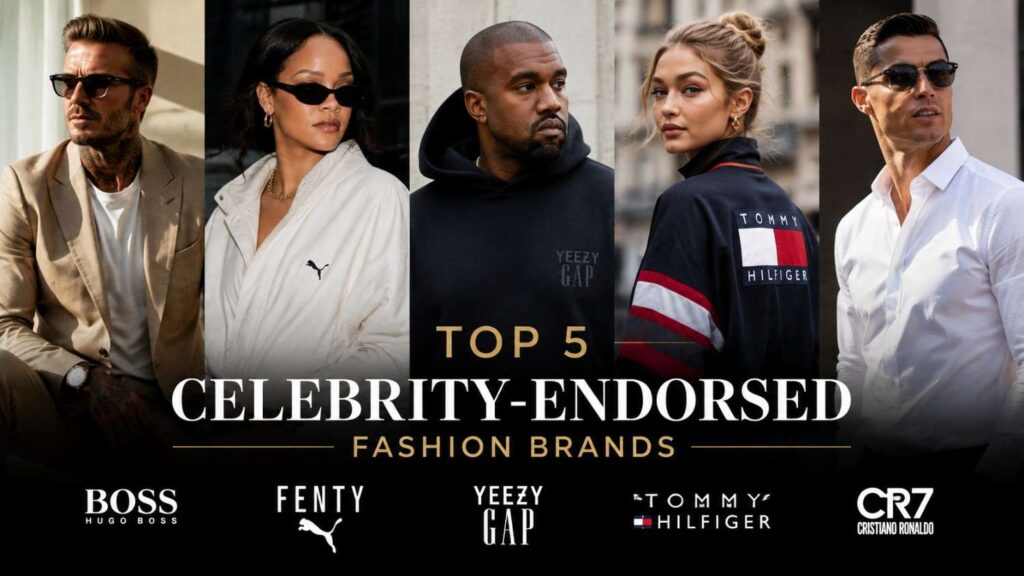
Top 5 Celebrity-Endorsed Fashion Brands to Know in 2026
Celebrity partnerships have become an important part of modern fashion marketing, particularly for global labels that compete for attention across social media, advertising, entertainment, red carpets, and international fashion events. Actors, musicians, athletes, and cultural personalities increasingly serve as more than temporary campaign faces. In many cases, they become recognizable representatives of a brand’s image for several seasons or contribute to product development through deeper creative collaborations.
That evolution is one reason the Top 5 Celebrity-Endorsed Fashion Brands deserve more careful analysis than a simple list of famous names. A celebrity photographed in a designer outfit is not necessarily endorsing the label. Genuine commercial relationships are usually supported by official campaign materials, brand announcements, ambassador titles, or documented collaborations. Understanding that distinction helps readers separate authentic brand partnerships from assumptions created by red-carpet coverage or social media.
In this guide, I focus on Louis Vuitton and Zendaya, CHANEL and JENNIE, Dior and JISOO, Calvin Klein and Bad Bunny, and BOSS and David Beckham. Each example demonstrates a different way fashion companies use celebrity influence. Some rely on traditional ambassadorship, while others connect stars directly to specific products or co-designed collections. The goal is not only to identify famous partnerships but also to explain why they work, how consumers should interpret them, and what to evaluate before buying celebrity-promoted fashion.
What Makes a Celebrity-Endorsed Fashion Brand Stand Out?
A strong celebrity endorsement does more than place a famous face beside a recognizable logo. The most effective partnerships create a believable relationship between the celebrity’s image, the fashion brand’s identity, and the products being promoted. When those elements align naturally, consumers can understand why the partnership exists instead of viewing it as another paid advertisement disconnected from the label’s style or audience.
Authenticity is especially important in fashion because clothing, accessories, and personal style are highly visible forms of self-expression. A celebrity who repeatedly wears or represents a brand can become closely associated with its visual language. That association becomes stronger when official campaigns continue across multiple seasons, involve important collections, or connect the celebrity with well-known products rather than relying on a single appearance.
However, visibility should not be confused with product quality. A successful ambassador may increase awareness and encourage shoppers to explore a collection, but the celebrity cannot determine whether an item is suitable for every consumer. I recommend treating celebrity fashion marketing as the beginning of the research process rather than the end. Once a campaign attracts your attention, evaluate the garment, handbag, footwear, or accessory based on its own characteristics, including materials, construction, fit, function, price, and how comfortably it integrates into your wardrobe.
Brand Ambassadorship vs. Simply Wearing a Brand
One of the most common misunderstandings in celebrity fashion coverage is assuming that every designer outfit represents a commercial endorsement. Celebrities frequently wear clothing selected by professional stylists, borrowed from fashion houses for events, purchased personally, or provided through informal industry relationships. None of these situations automatically proves that the individual has an official contract or ambassador role with the label.
A genuine ambassadorship is usually easier to verify because the fashion company publicly identifies the celebrity within its own marketing. Terms can include “House Ambassador,” “Global Ambassador,” “campaign face,” or another official designation. Brands may feature the individual on campaign pages, product launches, videos, social media accounts, runway-related content, or corporate announcements. Louis Vuitton’s identification of Zendaya as a House Ambassador and Dior’s formal references to JISOO as an ambassador are clear examples.
This distinction matters for both readers and publishers. From an editorial perspective, verified relationships make an article more accurate and trustworthy. From a consumer perspective, they provide useful context about why a celebrity repeatedly appears alongside certain products. One thing I always check first is whether the brand itself confirms the relationship. That simple verification step prevents casual fashion appearances from being misrepresented as paid or contractual endorsements.
Why Celebrity-Brand Fit Matters
Celebrity-brand fit refers to how naturally a public figure’s style, reputation, audience, and cultural image align with the fashion company they represent. A partnership usually feels more convincing when consumers can understand the connection without extensive explanation. For example, an actor known for influential red-carpet fashion may suit a luxury house, while an internationally recognized musician may be particularly effective for a lifestyle label seeking strong cultural visibility.
The audience overlap is equally important. Fashion companies are not simply borrowing fame; they are attempting to reach communities that already pay attention to the celebrity. When the celebrity’s followers are likely to appreciate the brand’s aesthetic, product categories, or positioning, the campaign can feel relevant rather than forced. This is particularly visible in partnerships involving K-pop stars, global musicians, professional athletes, and actors with international audiences.
Strong fit also creates room for a relationship to develop over time. A successful ambassador can appear in multiple campaigns, attend fashion events, promote different product categories, or eventually participate in deeper collaborations. For consumers, longevity provides a useful signal that the partnership is more substantial than a one-season promotional moment. It still does not guarantee that every product is worth buying, but it often produces more coherent storytelling and more recognizable fashion inspiration.
Comparing the Top Celebrity Fashion Partnerships
Comparing celebrity fashion partnerships requires more than ranking the fame of the people involved. Each brand operates within a different market position and product category. Louis Vuitton, CHANEL, and Dior are global luxury houses with strong heritage identities, while Calvin Klein has broad recognition in underwear, denim, and lifestyle apparel. BOSS, meanwhile, has a particularly strong association with modern menswear, tailoring, and sophisticated casual dressing.
The celebrity relationships also differ in structure. Zendaya, JENNIE, and JISOO have been officially positioned as ambassadors connected with their respective luxury houses. Bad Bunny has appeared as the featured star of a dedicated Calvin Klein campaign, while David Beckham’s relationship with BOSS has moved into collaborative design. These differences matter because “celebrity endorsement” is a broad term that can describe several types of commercial and creative arrangements.
For shoppers, comparison should therefore focus on how each partnership relates to the products they actually want to buy. Someone researching handbags may find Louis Vuitton or Dior more relevant, while a shopper interested in modern menswear may pay closer attention to BOSS. Consumers looking for everyday basics may find Calvin Klein more immediately accessible. The strongest approach is to use the celebrity relationship as a discovery mechanism and then compare individual products according to practical criteria rather than assuming that every collaboration serves the same customer.
Related Articles
Celebrity-Endorsed Fashion Brand Comparison
The table below provides a concise overview of the five featured partnerships. It highlights the celebrity, the nature of the documented relationship, and the fashion categories most closely associated with each example. The purpose is not to rank one brand as objectively superior but to help readers quickly understand how different celebrity fashion campaigns operate across luxury, lifestyle, and menswear markets.
| Fashion Brand | Featured Celebrity | Official Relationship/Campaign | Key Fashion Area |
|---|---|---|---|
| Louis Vuitton | Zendaya | House Ambassador | Luxury fashion, handbags, accessories |
| CHANEL | JENNIE | House Ambassador | Luxury ready-to-wear and accessories |
| Dior | JISOO | Fashion and beauty ambassador | Luxury fashion, handbags, beauty |
| Calvin Klein | Bad Bunny | Official campaign star | Underwear and lifestyle apparel |
| BOSS | David Beckham | Multi-year partnership and co-designed collections | Menswear, tailoring, casualwear |
The comparison shows how widely celebrity involvement can vary. Some relationships center on ambassador representation across a fashion house, while others focus on particular advertising campaigns or product collaborations. This variation is useful for readers because it demonstrates that celebrity endorsement should not be treated as a single standardized marketing model.
When comparing these brands, also consider your own shopping priorities. A luxury ambassador campaign may emphasize craftsmanship, heritage, and aspirational styling, while an underwear campaign may focus more directly on everyday products. A co-designed collection introduces another layer because the celebrity may influence the creative direction rather than simply modeling an existing product.
Celebrity Partnership Type and Fashion Focus
| Brand & Celebrity | Partnership Type | Primary Fashion Focus | Collaboration Depth | Main Consumer Appeal |
|---|---|---|---|---|
| Louis Vuitton & Zendaya | House Ambassador | Luxury fashion, handbags, accessories | Ambassador campaigns and product storytelling | High-fashion visibility and luxury styling |
| CHANEL & JENNIE | House Ambassador | Ready-to-wear, handbags, shoes, accessories | Seasonal campaigns and collection representation | Contemporary luxury and global pop-culture influence |
| Dior & JISOO | Fashion & Beauty Ambassador | Handbags, fashion, beauty | Campaigns and product-focused storytelling | Luxury fashion, handbags, and beauty |
| Calvin Klein & Bad Bunny | Campaign Partnership | Underwear, denim, lifestyle apparel | Official advertising campaign | Everyday fashion and contemporary celebrity appeal |
| BOSS & David Beckham | Strategic Partnership & Design Collaboration | Tailoring, casualwear, menswear | Campaigns plus co-designed collections | Modern menswear and celebrity-led product development |
How to Evaluate a Celebrity-Endorsed Brand Before Buying
The first step is to verify that the partnership is genuine. Visit the fashion company’s official website, newsroom, campaign archive, or verified social channels before relying on fan pages or secondary posts. This is particularly useful when online discussions use the word “ambassador” loosely. An official source can clarify whether the celebrity has a formal role, appears in a specific campaign, or participated in a genuine collaboration.
Next, evaluate the actual product independently. Check the material composition, sizing information, dimensions, care instructions, construction, available colors, intended use, and return conditions. If you are buying an expensive handbag, coat, pair of shoes, or tailored garment, these practical details matter far more over time than the person featured in the campaign. Luxury purchases especially deserve careful comparison before checkout.
Finally, ask whether the item fits your lifestyle and existing wardrobe. A striking celebrity campaign can make a product look essential even when it would rarely be used in everyday life. I recommend considering how many outfits you could realistically create with the item and whether you would still want it without the celebrity association. That simple question helps separate genuine personal preference from temporary campaign excitement.
Key Factors for Evaluating Celebrity-Endorsed Fashion Products
| Evaluation Factor | What to Check | Why It Matters | Example from the Article |
|---|---|---|---|
| Celebrity Partnership | Official ambassador, campaign, or collaboration status | Confirms the relationship is more than an unofficial celebrity appearance | Zendaya is officially identified as a Louis Vuitton House Ambassador |
| Product Quality | Materials, construction, finishing, and durability | Celebrity promotion does not guarantee product quality | Luxury handbags from Louis Vuitton and Dior should be evaluated individually |
| Fit & Sizing | Measurements, cut, proportions, and intended use | A campaign look may not translate directly to every customer | Calvin Klein apparel requires attention to sizing and fit |
| Personal Style | Color, silhouette, versatility, and wardrobe compatibility | Helps separate celebrity influence from individual preferences | JENNIE’s CHANEL styling can provide inspiration without requiring an exact outfit copy |
| Price & Value | Cost compared with expected use and longevity | Prevents celebrity hype from becoming the main purchasing reason | Designer products should be considered for long-term wardrobe value |
| Return & Retailer Policy | Authorized retailer, returns, exchanges, and purchase terms | Adds practical protection when buying fashion products | Official brand channels or authorized retailers are preferable |
1. Louis Vuitton and Zendaya
Louis Vuitton and Zendaya represent one of the most recognizable contemporary relationships between a luxury fashion house and a major film star. Zendaya has developed a reputation for highly visible red-carpet fashion, experimental styling, and carefully constructed public appearances, making her a natural fit for a brand that combines heritage luxury with global celebrity culture. Louis Vuitton formally identifies her as a House Ambassador.
The partnership is especially valuable from a fashion-marketing perspective because it extends beyond merely dressing Zendaya for events. Louis Vuitton has incorporated her into official storytelling around important products and projects. Her presence in campaigns connected with the Speedy handbag and Louis Vuitton x Murakami demonstrates how an ambassador can help refresh attention around established house codes while introducing them to younger and highly engaged audiences.
Among the Top 5 Celebrity-Endorsed Fashion Brands, this pairing stands out because Zendaya’s own fashion image already attracts extensive attention. That gives Louis Vuitton access to an audience actively interested in styling rather than celebrity culture alone. Still, shoppers should view the partnership as inspiration rather than an automatic buying recommendation. Louis Vuitton products vary significantly in size, construction, function, and price, so anyone considering a purchase should evaluate the individual item rather than relying solely on the strength of the campaign.
Zendaya’s Role as a Louis Vuitton House Ambassador
Louis Vuitton officially describes Zendaya as a House Ambassador, establishing the relationship as more than a sequence of unrelated fashion appearances. This designation means that her connection with the house forms part of its official communication strategy. She has appeared in Louis Vuitton campaign storytelling and has been connected with high-profile products and creative projects promoted through the brand’s own channels.
One prominent example is the Speedy handbag. Louis Vuitton has featured Zendaya in its official Speedy content, linking her image with one of the house’s widely recognized handbag families. She has also appeared in material connected with the Louis Vuitton x Murakami re-edition, which brought renewed attention to the collaboration between the fashion house and artist Takashi Murakami.
For SEO and editorial purposes, this official documentation is important because it makes the Zendaya Louis Vuitton relationship verifiable. Readers researching luxury fashion ambassadors can distinguish the partnership from a casual celebrity sighting.
Who Should Pay Attention to the Partnership?
The Louis Vuitton and Zendaya partnership is particularly relevant for readers interested in luxury handbags, high-fashion styling, accessories, red-carpet trends, and contemporary interpretations of heritage fashion. Zendaya’s public style often demonstrates how established luxury pieces can be presented in a modern context, which makes campaign imagery useful for inspiration even when the exact products are outside a shopper’s budget.
Luxury consumers can also use campaigns like these to discover specific handbag families, silhouettes, colors, or styling combinations that they may not have researched independently. However, a professional buying decision should move beyond campaign imagery. Look carefully at product dimensions, materials, closure systems, strap options, weight, capacity, and how the item will function in your daily routine.
Budget-conscious readers can still gain value without purchasing the featured luxury product. Instead of copying a complete celebrity outfit, identify transferable ideas such as proportion, color coordination, layering, or how a structured handbag changes an otherwise simple look. Celebrity fashion works best as a source of styling inspiration when shoppers adapt the concept to their own needs and price range.
2. CHANEL and JENNIE
JENNIE’s relationship with CHANEL illustrates how strongly luxury fashion and global music culture have become interconnected. As a member of BLACKPINK and a widely recognized style figure, JENNIE reaches audiences far beyond traditional fashion-media readers. CHANEL has formally referred to her as a House ambassador and has featured her prominently in official fashion campaigns, confirming the relationship through its own brand channels.
The partnership works because JENNIE can move between polished luxury styling and more relaxed contemporary fashion without losing a recognizable personal identity. That versatility gives CHANEL opportunities to present classic house elements to audiences who may also be interested in streetwear, modern tailoring, denim, accessories, and music-driven style trends. Her campaign work can therefore connect established luxury codes with younger global consumers.
The relationship also demonstrates why fashion brand ambassadors have become more strategically important. Luxury houses increasingly compete for attention in a media environment where audiences move between fashion shows, music videos, social platforms, entertainment coverage, and celebrity culture. An ambassador with international recognition can connect these environments. For shoppers, the useful lesson is to examine how CHANEL pieces are styled in the campaign and then decide which elements—rather than necessarily the entire look—fit their own wardrobe, budget, and personal fashion preferences.
JENNIE as a CHANEL House Ambassador
CHANEL’s official campaign material identifies JENNIE as a House ambassador, providing clear confirmation of her relationship with the French luxury label. She has appeared in major brand imagery, including the Fall-Winter 2025/26 Pre-Collection campaign. That campaign positioned her within a Paris-focused visual narrative rather than treating her appearance as a separate celebrity endorsement disconnected from the fashion collection.
The collection incorporated multiple categories, including ready-to-wear, handbags, shoes, costume jewelry, small leather goods, and accessories. This breadth is important because it allows JENNIE’s ambassador role to connect with more than a single product. It also gives readers a wider range of styling ideas, whether they are interested in tailoring, knitwear, handbags, footwear, or smaller accessories.
From an editorial standpoint, official CHANEL campaign pages provide stronger evidence than social-media speculation or unofficial ambassador lists. They document how the brand itself describes JENNIE’s role and how she appears within its fashion storytelling.
Why the Partnership Is Important for Global Fashion
The CHANEL and JENNIE partnership reflects the increasingly international nature of luxury fashion influence. Major fashion houses no longer depend primarily on actors from traditional Western entertainment markets. Musicians and performers from South Korea and other global cultural centers now play significant roles in luxury campaigns, fashion-week visibility, and brand communication across multiple regions.
JENNIE is particularly effective because her influence sits at the intersection of music, fashion, entertainment, and digital culture. A single campaign can therefore reach established CHANEL customers as well as younger audiences who may first encounter the brand through celebrity content. That cross-generational exposure helps explain why global musicians have become attractive ambassador choices for major luxury labels.
For shoppers, however, global popularity should not replace personal judgment. Study how a CHANEL campaign combines silhouettes, textures, footwear, accessories, and proportions, then identify the elements that genuinely work for you. You do not need an entire designer look to benefit from the styling. Often, one carefully chosen accessory, fabric contrast, or layering idea is more useful than attempting to reproduce a campaign from head to toe.
3. Dior and JISOO
Dior’s relationship with JISOO is another important example of how luxury fashion houses work with globally recognized music personalities. Dior officially identifies JISOO as an ambassador across fashion and beauty, giving the partnership a broader scope than a single collection or campaign. Her presence has been connected with recognizable Dior products, including the Lady Dior handbag, through dedicated brand communications.
The partnership makes strategic sense because Dior operates across multiple luxury categories. Fashion, handbags, accessories, fragrance, and beauty all contribute to the house’s broader identity, and an ambassador who can appear naturally within several of those areas gives the company greater consistency. JISOO’s polished public image also aligns easily with the refined presentation commonly associated with Dior campaigns.
For readers comparing celebrity fashion brands, the Dior example is particularly useful because it shows how one ambassador can support multiple dimensions of a luxury house. The relationship can attract consumers through a handbag campaign, fashion-week appearance, beauty promotion, or editorial image while maintaining recognizable continuity. As with every partnership in this guide, however, celebrity visibility should encourage product research rather than replace it. A Dior item should ultimately be judged on its design, materials, practicality, price, and suitability for the individual shopper.
JISOO’s Official Dior Ambassador Role
Dior officially describes JISOO as an ambassador for fashion and beauty, making her relationship with the house straightforward to verify. Her role has included dedicated imagery and campaign content connected with important Dior products. One notable example is the Lady Dior campaign, in which the brand directly places her within the storytelling surrounding one of its signature handbag lines.
JISOO has also appeared in campaign material for the Lady 95.22 bag, reinforcing the connection between her ambassador role and Dior’s handbag portfolio. Repeated involvement matters because it demonstrates an ongoing brand relationship rather than an isolated appearance. It also gives consumers multiple opportunities to see how the house styles recognizable pieces across different campaign concepts.
For publishers and readers, Dior’s own fashion news and campaign pages remain the best starting point for verification. They clarify both JISOO’s ambassador status and the specific products connected with her appearances.
What Makes Dior and JISOO a Strong Pairing?
A strong fashion partnership usually feels visually consistent, and Dior’s work with JISOO benefits from that sense of coherence. Her public image often emphasizes polished styling, elegant silhouettes, and carefully selected accessories, all of which can integrate naturally with Dior’s luxury positioning. The result is a campaign relationship that appears deliberate rather than based only on audience size.
When sunscreen is part of that routine, sunscreen for your skin type can help make daily use more comfortable and consistent.
The fashion-and-beauty dimension also gives the collaboration added flexibility. Instead of restricting JISOO to one type of promotion, Dior can connect her image with handbags, fashion collections, beauty storytelling, and other brand moments. That wider role can strengthen recognition because consumers repeatedly encounter the same celebrity within different parts of the brand ecosystem.
For readers who also follow Dior’s beauty side, choosing the right SPF can be a simple part of keeping everyday skincare practical alongside fashion and beauty routines.
Shoppers should still separate the effectiveness of the partnership from the value of an individual product. If a Lady Dior campaign sparks interest, research size options, materials, handle and strap configurations, capacity, maintenance, and how often the bag would realistically be used. Luxury campaigns sell an aesthetic, while a smart purchasing decision depends on how successfully that product fits real life.
4. Calvin Klein and Bad Bunny
Calvin Klein offers a different example from the traditional luxury houses featured earlier in this guide. The brand has long been strongly associated with underwear, denim, casual apparel, and lifestyle-focused advertising, which means celebrity campaigns can connect directly with familiar everyday product categories. Its work with Bad Bunny demonstrates how a globally recognized musician can bring additional cultural relevance to products consumers already understand.
Bad Bunny’s international music career gives Calvin Klein access to audiences across multiple markets and languages. More importantly, the campaign does not require consumers to understand luxury-fashion history or runway concepts before engaging with the product. Underwear is an immediately recognizable category, allowing the celebrity’s presence to support attention and brand identity while keeping the merchandise itself simple and easy to understand.
Within the Top 5 Celebrity-Endorsed Fashion Brands, Calvin Klein therefore represents a more accessible style of celebrity marketing. The company is not relying on couture-level exclusivity or heritage handbags in this example. Instead, it places cultural visibility around an everyday wardrobe category. That approach can be powerful, but shoppers should still consider fit, fabric, support, sizing, comfort, and care instructions before purchasing. Celebrity appeal may create interest, but those practical details determine whether the product works after the campaign image is forgotten.
Bad Bunny’s Calvin Klein Campaign
Calvin Klein has featured Bad Bunny in an official campaign connected with its Icon Cotton Stretch underwear collection. Because the campaign appears through Calvin Klein’s own channels, the relationship can be verified without relying on unofficial reports. The musician is presented directly in connection with the brand’s product line, making this a clear example of a formal celebrity fashion campaign.
The partnership demonstrates how brands can use cultural personalities to refresh attention around familiar product categories. Underwear may be a basic wardrobe purchase, but a major campaign can turn a functional product into a broader lifestyle message. Bad Bunny’s image brings contemporary music, individuality, and global pop-culture visibility into that communication.
For consumers, the campaign may be a useful starting point for discovering the collection, but product research remains essential. Check the fiber composition, waistband construction, available fits, size guide, care requirements, and return policy before ordering.
Why Calvin Klein’s Approach Feels Different
Calvin Klein’s campaign feels different because it focuses on a product category many consumers already purchase regularly. Luxury-brand ambassador campaigns often promote aspirational handbags, runway fashion, or high-end accessories. Underwear, by contrast, is practical and personal. The celebrity may attract attention, but comfort and fit quickly become more important once a shopper considers actually buying the item.
This accessibility can make the marketing feel more immediate. Consumers do not need to imagine how a runway piece could translate into daily life because the product already belongs in an everyday wardrobe. The campaign’s role is therefore less about explaining what the item is and more about creating a distinctive cultural identity around a familiar category.
That does not mean buying should become impulsive. Underwear performance varies according to body shape, personal comfort preferences, fabric sensitivity, sizing, and intended use. I recommend reading the official size guide carefully rather than assuming the model’s appearance indicates how the product will fit everyone. Strong advertising attracts attention; accurate sizing and comfort determine long-term satisfaction.
5. BOSS and David Beckham
The relationship between BOSS and David Beckham differs from many standard celebrity endorsements because it includes a documented creative collaboration. Beckham is not simply appearing in advertising imagery for an existing menswear line. HUGO BOSS announced a multi-year strategic partnership that expanded into co-designed collections, giving the relationship a direct connection with product development as well as marketing.
That added level of involvement is significant. Celebrity endorsements usually ask consumers to associate a familiar personality with a product, while a design collaboration raises additional questions about creative input, styling direction, and how the celebrity’s own wardrobe identity influences the collection. Beckham’s long-standing association with tailored menswear and polished casual clothing makes this format particularly logical for BOSS.
For shoppers, the partnership offers a useful example of why it is important to identify the type of celebrity relationship involved. A campaign face, brand ambassador, and design collaborator are not interchangeable roles. BOSS by Beckham is especially relevant to consumers interested in modern menswear because the product story extends across tailoring, shirts, polos, knitwear, denim, outerwear, and casual pieces. The collection can therefore be evaluated as a coordinated wardrobe proposition rather than simply a one-product advertising campaign.
From Campaign Star to Design Collaboration
HUGO BOSS announced a multi-year strategic partnership with David Beckham that included both formal and casual menswear. The relationship later expanded into BECKHAM x BOSS, with the company describing its Spring/Summer 2025 collection as the first BOSS collection co-designed with Beckham. This moved the partnership beyond conventional modeling and gave the celebrity a documented role within the product-development story.
The collaboration continued beyond the first release. For Spring/Summer 2026, BOSS presented another BOSS BY BECKHAM collection spanning tailoring and warm-weather casualwear. Continuing the concept across seasons gives the relationship greater depth and suggests that BOSS sees the collaboration as more than a temporary promotional moment.
For consumers, that continuity makes it easier to understand what the partnership represents: a recurring menswear direction rather than a single advertisement.
Who Is the BOSS by Beckham Collection For?
BOSS by Beckham is particularly relevant to men who prefer polished wardrobes that can move between professional, smart-casual, and relaxed settings. The partnership has included tailoring as well as more casual categories, making it suitable for shoppers building a coordinated wardrobe rather than looking only for a single statement piece. Shirts, knitwear, trousers, denim, polos, and tailored garments can all serve different everyday needs.
The aesthetic may appeal especially to consumers who like clean silhouettes, understated styling, and clothing that can be combined easily. Instead of relying on highly experimental fashion, the collection’s value for many shoppers lies in versatility. A tailored jacket that works with trousers and denim, for example, may deliver more practical value than a dramatic piece worn only occasionally.
Still, collaboration branding should not replace standard clothing evaluation. Check fabric composition, cut, measurements, alterations, maintenance requirements, and compatibility with your existing wardrobe. A co-designed celebrity collection may provide useful inspiration, but the best purchase remains the garment that fits correctly, feels comfortable, and can be worn frequently enough to justify its cost.
Quick Answer About Top 5 Celebrity-Endorsed Fashion Brands
The Top 5 Celebrity-Endorsed Fashion Brands in this editorial guide are Louis Vuitton with Zendaya, CHANEL with JENNIE, Dior with JISOO, Calvin Klein with Bad Bunny, and BOSS with David Beckham. These selections are based on documented brand relationships rather than informal celebrity sightings. Each fashion company has publicly featured the celebrity through an ambassador role, official advertising campaign, long-term partnership, or collaborative collection.
What makes these partnerships especially interesting is that they represent different approaches to celebrity fashion marketing. Louis Vuitton, CHANEL, and Dior connect internationally recognized personalities with luxury fashion, accessories, and brand storytelling. Calvin Klein uses a major recording artist to bring attention to its lifestyle and underwear categories, while BOSS has developed its David Beckham partnership beyond advertising and into co-designed menswear collections.
For consumers, the main takeaway is not that a famous endorsement automatically makes one fashion brand better than another. Celebrity partnerships are most useful as a discovery tool. They can introduce shoppers to new collections, styling ideas, silhouettes, or product categories, but quality, fit, materials, price, versatility, and personal taste should still guide a final purchase. Throughout this guide, I examine both the celebrity relationship and what it means for everyday fashion shoppers.
Frequently Asked Questions About Top 5 Celebrity-Endorsed Fashion Brands
Celebrity-fashion partnerships generate many search questions because the terminology used by brands, media outlets, and fans is not always consistent. A person may be called an ambassador in online discussions even when the fashion company itself has only featured them in one campaign. In other cases, a celebrity may genuinely hold a long-term ambassador position that spans several seasons and product categories.
Understanding these differences is useful for anyone researching fashion trends or deciding whether celebrity promotion should influence a purchase. Official brand websites remain the strongest starting point because they clarify whether a celebrity is described as an ambassador, campaign star, collaborator, or another type of partner. Secondary reporting can add context, but it should not replace confirmation from the company involved.
The following FAQs address the most common search intents surrounding the Top 5 Celebrity-Endorsed Fashion Brands, including ambassador status, the purpose of celebrity partnerships, and how consumers should interpret them. Each answer focuses on practical information rather than celebrity gossip. The goal is to help readers understand both the marketing relationship and the limits of what an endorsement can tell them about an individual fashion product.
What are celebrity-endorsed fashion brands?
Celebrity-endorsed fashion brands are clothing, footwear, accessory, or luxury companies that formally work with recognizable public figures to promote or help develop products. The relationship can take several forms, including an ambassador contract, advertising campaign, sponsored appearance, capsule collection, or longer-term design collaboration.
These partnerships are common because celebrities bring established audiences and recognizable personal identities. A well-matched ambassador can help a brand communicate its image quickly, particularly when the celebrity’s style and followers overlap with the customers the company wants to reach.
However, a celebrity simply wearing a brand does not automatically indicate an endorsement. Stylists frequently borrow clothing for events, and public figures may also purchase products independently. For accurate information, readers should look for confirmation from the fashion brand itself before describing a celebrity as an official ambassador or collaborator.
Which celebrities are ambassadors for luxury fashion brands?
Several major luxury houses maintain official celebrity ambassador relationships. Among the examples covered in this article, Louis Vuitton identifies Zendaya as a House Ambassador, CHANEL has described JENNIE as a House ambassador, and Dior formally identifies JISOO as an ambassador within fashion and beauty.
These roles typically involve more than a single public appearance. Ambassadors may appear in campaign photography, videos, fashion events, product launches, runway-related communication, editorial content, and other official brand materials. The exact responsibilities and contractual arrangements are not always publicly disclosed.
Because ambassador rosters can change, official fashion-house websites are the best source for current verification. Readers should be cautious with generic online lists that may combine active ambassadors, former ambassadors, campaign models, and celebrities who have simply worn the brand. Confirming the relationship protects both editorial accuracy and consumer understanding.
Is Zendaya a Louis Vuitton ambassador?
Yes. Louis Vuitton has officially identified Zendaya as a House Ambassador and has featured her through its own campaign and product storytelling. Her relationship with the fashion house is therefore a documented partnership rather than an assumption based only on red-carpet appearances.
Zendaya has been connected with Louis Vuitton’s Speedy handbag campaign content and has also appeared in imagery associated with Louis Vuitton x Murakami. These appearances demonstrate how the house uses her public image to support both recognizable product families and high-profile creative projects.
For readers researching the relationship, Louis Vuitton’s own website provides the strongest confirmation. This is important because celebrities often wear multiple designers throughout a year, especially during awards season. An official House Ambassador designation distinguishes Zendaya’s Louis Vuitton relationship from simply choosing or being styled in a designer outfit for one event.
Is JISOO a Dior ambassador?
Yes. Dior’s official fashion communications identify JISOO as an ambassador across fashion and beauty. She has appeared in dedicated brand campaigns, including material focused on well-known Dior handbag lines such as Lady Dior.
Her relationship with the house illustrates how luxury ambassadors can work across multiple categories. Rather than limiting JISOO to a single fashion collection, Dior can connect her image with handbags, clothing, accessories, beauty, events, and broader brand storytelling.
Consumers interested in a product because of JISOO’s campaign should still research the item independently. For example, someone considering a Dior handbag should compare sizes, materials, carrying options, capacity, care requirements, and cost. The ambassador creates awareness and inspiration, while the product’s practical qualities determine whether it is actually right for the buyer.
Is JENNIE a CHANEL ambassador?
Yes. CHANEL has officially referred to JENNIE as a House ambassador in its own fashion campaign materials. She has appeared prominently in CHANEL imagery, including the Fall-Winter 2025/26 Pre-Collection campaign.
Her work with the house reflects the growing importance of internationally recognized music artists within luxury-fashion marketing. JENNIE’s influence extends across music, fashion, social media, and entertainment, allowing CHANEL campaigns to reach both established luxury consumers and younger global audiences.
For accurate editorial use, CHANEL’s official campaign pages are preferable to fan-made ambassador lists. Those pages establish the terminology used by the house itself and show the specific campaigns in which JENNIE appears. That distinction helps readers separate a genuine ambassador relationship from the far more common situation in which a celebrity simply wears a designer’s clothing.
Does David Beckham design clothes for BOSS?
David Beckham has participated in a documented design collaboration with BOSS. HUGO BOSS announced a multi-year strategic partnership with him and later introduced collections that the company described as co-designed with Beckham.
This makes the relationship different from a conventional advertising role. Beckham’s involvement is connected with the creation and direction of menswear collections rather than limited to modeling finished garments. BOSS has continued the concept across multiple seasons, covering both formal and casual categories.
Consumers should still evaluate individual garments as they would with any other clothing purchase. A celebrity’s involvement in design can make a collection more interesting, but fit, tailoring, fabric, construction, comfort, care requirements, and wardrobe versatility remain the most important factors. Collaboration adds context to the product; it does not remove the need for practical comparison.
Should I buy a fashion brand because a celebrity endorses it?
A celebrity endorsement can be a useful way to discover a product, but it should not be the main reason you buy it. Campaigns are designed to make clothing and accessories visually appealing, and a celebrity’s personal image can strengthen that effect. The product still needs to work for your own needs after the advertisement is gone.
Start by evaluating fit, materials, construction, comfort, durability, maintenance, versatility, and price. For luxury items, also consider how often you will realistically use the product and whether its cost makes sense within your budget. Return policies and authorized-retailer status are important as well.
One useful test is to ask whether you would still want the item if a different person appeared in the campaign. If the answer is yes, the celebrity may simply have helped you discover something that genuinely suits your taste. If the answer is no, waiting before purchasing may prevent an impulse decision.
Conclusion
The Top 5 Celebrity-Endorsed Fashion Brands examined in this guide demonstrate how varied modern fashion partnerships have become. Louis Vuitton uses Zendaya as a House Ambassador, CHANEL features JENNIE within its luxury fashion storytelling, Dior works with JISOO across fashion and beauty, Calvin Klein has placed Bad Bunny at the center of an official underwear campaign, and BOSS has expanded its David Beckham relationship into multi-season collaborative design.
Together, these examples show that celebrity endorsement is no longer limited to placing a famous person in an advertisement. Ambassadors can become recurring representatives of a house, musicians can introduce familiar products to new audiences, and established public figures can move into collaborative product development. For brands, these partnerships create visibility and cultural relevance. For consumers, they provide inspiration and a convenient way to discover collections that might otherwise go unnoticed.
The smartest buying strategy, however, remains product-focused. Enjoy the campaign, study the styling, and use celebrity fashion as a source of ideas, but evaluate every purchase according to your own priorities. Fit, quality, materials, functionality, versatility, price, and personal style matter more in the long term than the person appearing in an advertisement. When celebrity inspiration and practical product research work together, fashion marketing can become genuinely useful rather than simply persuasive.